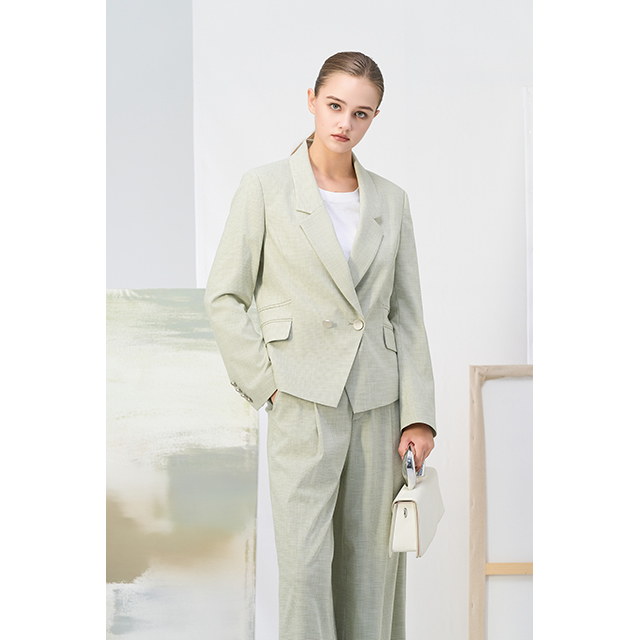
Wide-leg pants have a comedic balance. They’re considered one of the most beautiful silhouettes ever conceived—fluffy, long, and almost architectural when they move— yet people still have concerns regarding appearing unkempt when purchasing a pair. The general fear is caused by misinterpreting the principles of physics and the rules of geometry involved in fabric. Wide-leg pants promote volume, and the behavior of volume is different on the human body than isfits. When the equilibrium is tipped a bit, the gaze decays; when it’s correct, the clothing feels purposeful, molded, and possesses a remarkably sharp appearance.
What is unique about wide-leg pants is the motion they rely on. A skinny jean is unable to move; it adheres to the jean and cannot be moved. A long leg is more analogous to a moving platform. It drapes, slings, folds, and admits. When individuals claim that they are afraid of looking sloppy, the truth is that they are in fear of losing control of their movement. However, movement can be manipulated— via the waist’s position, via the fabric’s weight, via the role of the top, or via the way shoes imbue the entire composition with a visual presence.
Once those levers are rationalized, the silhouette will become one of the most attractive shapes in the modern Wardrobe. It increases the length of the legs, softens the hips, and demonstrates a simple, yet sophisticated, style that pants that are too tight will not be able to match. Wearing wide-leg pants correctly is not about deception; it’s about comprehending how the body’s vertical lines interact with fabric that is supposed to drape rather than stick.
Proportion, Structure, and the Geometry of Balance
Getting wide-leg pants correct starts with the proportion. You don’t require strict rules regarding fashion; these typically fail when someone with genuine style ignores them, but you do require an understanding of how the volume is distributed across the body. Consider the outfit as a simple mathematical formula: the larger the pants, the more important the top half is to convey a defined sense of intention over an accidental impression.
Waist Placement and Why It Shapes Everything
The waist of wide-leg pants is the silent creator of the entire style. High-waisted variations increase the length of the legs, draw the torso up, and create a vertical line that the wide leg then amplifies. Mid-rise versions soften the line and have a more laid-back feel, but they require a top that is aware of the waist in some way– either by tucking in, knotting, or by ending on the proper length. Low-rise wide-legs are present, but they are also more complicated to create, because they take away the torso-to-leg distinction that facilitates the organization of volume.
A clean waistband is one of the simplest ways to appear fresh. The fabric of the moment is located around the lower part of the abdomen, which creates the impression of a heavy silhouette. A thin waistband, however, provides the viewer with a place to relax. It’s a pivotal point that connects the upper and lower parts of the clothing. Even if the pants are extremely wide, a defined waist counteracts the impression of a lack of shape.
Why Fabric Weight Matters More Than Most People Realize
The fabric’s weight determines the motion personality of wide-leg pants. Stiff fabric, heavy denim, or thick wool creates an architectural design that barely fluctuates, almost like a column. These fabrics instill confidence because they do not fold into wrinkles or attach to locations that should not. Light fabrics, such as Rayon, chiffon, and crepe, are beautiful to look at, but they require a more considerate top because of their flutter, which is soft, slimy, and extremely fluid.
Those who feel disheveled in pants with wide legs often wear fabric that alters their natural posture. If the fabric is too translucent, the pants may bind to the thigh or have a crotch bind. If the fabric is too dense, the leg will appear as a solid block. A fabric that has a middle-range weight of linen, towels, and wool tends to have the greatest degree of balance between motion and structure.
The Role of Vertical Lines
Wide-leg pants are successful in garnering attention. Anything that extends the line—from pleats to full-length creases to uninterrupted fabric—will help to direct the eye downward, which will decrease the likelihood of having bulk. That’s why pressed pants have such a tailored appearance: the crease functions as an extra structure, a skeleton that facilitates the flow of fabric.
Also, pleats have a subtle effect on psychology. They indicate that the width is intended, not by chance. A wide-legged pant that is pleated says something like “I am supposed to have this shape.” This shape avoids a flabby appearance because the structure eliminates ambiguity. Even a small amount of front slack can alter the entire posture of the pants.

The Strategic Use of Tops, Footwear, and Overall Silhouette
Many people believe that wide-leg pants require a complete top. That concept is partially accurate, but not entirely so. What is actually important is clarity— Does the top define the shape of the body, or does it blend into the pants? The top can be omitted, but it must instead help to contribute to the silhouette instead of diluting it.
Below are three list-style sections (the recommended amount), each dealing with a vital aspect of style.
Tops That Bring Definition Without Tightness
• Structured blouses help create a crisp outline that contrasts with the softness of the wide leg.
• Cropped tops work because they end precisely where the waist needs definition. They’re efficient, not revealing.
• Knits with some rigidity (not slouchy, not extra-oversized) maintain balance, especially when half-tucked.
• Button-downs gain sharpness when tucked cleanly; they keep the look intelligent rather than lounge-like.
The top functions like the stabilizing element of a mobile sculpture. It doesn’t have to dominate; it simply has to direct the movement of the pants.
Shoes That Anchor the Silhouette
• Pointed-toe flats create a directional line that strengthens the vertical drop of the pant.
• Block heels add mass at the bottom, preventing the pants from visually “dragging.”
• Sneakers with a minimal profile work when the pant length hovers slightly above the ground.
• Sandals with a bit of structure (not mushy soles) keep the look polished during warm seasons.
Footwear is where many outfits fail. When the shoes collapse—too soft, too round, too bulky—the entire silhouette sinks. Good shoes act like punctuation; they complete the sentence.
Outerwear That Works With, Not Against, Wide Legs
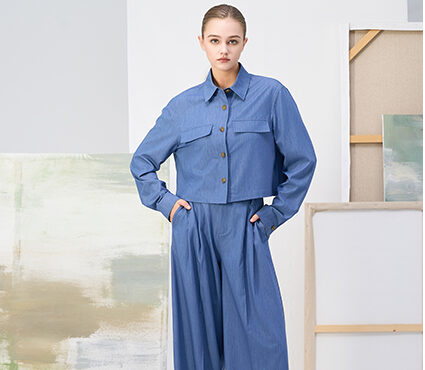
• Cropped jackets reinforce the waist and prevent volume overload.
• Long coats with sharp shoulders elongate the frame and create a powerful vertical line.
• Blazers slide easily over wide-leg pants because both shapes rely on clean geometry.
• Avoid extremely slouchy cardigans unless the pants are very structured.
Outer layers distribute volume. When outerwear is crisp, the wide-leg pant feels intentional. When outerwear is shapeless, the entire outfit blurs.
Movement, Confidence, and the Psychology of Volume
Wide-leg pants affect the way people move. They promote longer steps, more dramatic pivots, and more fabric-supported movement. That confidence is derived not only from the fashionable appearance of the item, but also from the kinetic experience of wearing it. A person in flannel pants has a different movement style than someone in jeans. The silhouette promotes relaxation. Ease is a signal of trust.
Frumpiness is frequently a psychological issue, rather than a fashionable one. If you believe you’re concealed by the fabric, your posture will respond: shoulders will slump, steps will shorten, and the outfit will become unflattering, not because of the pants, but because of the body’s response to ambiguity. When the numbers are balanced, faith returns—and motion conveys that confidence.
One of the most effective ways to discover what works is to experiment at home with three different aspects: the walking distance, the mirror’s viewing angles, and the natural posture. Wide-leg pants are most apparent in movement. Stop moving, and they may appear obvious. Walk across the room, and they suddenly become more dramatic.
Color, Pattern, Texture, and the Art of Visual Weight
The concept of flabby is often associated with the weight of the visual presentation. Dark colors appear heavier, light colors appear airy, and patterns can be either sized down or up depending on the scale. Many people misinterpret this and believe that wide-leg pants are only black or navy colors. False. Earth tones, soft whites, muted greens, and textured neutrals can appear remarkably detailed when combined with the appropriate top.
Also, texture has an effect on weight. A rough linen has a relaxing appearance; a smooth wool has a serious appearance. The combination of textures results in a hierarchy that prevents the eye from straying. If the pants have a lot of patterns, maintain the top’s smoothness. If the pants have a smooth, flowing pattern, a textured top part creates attention.
Patterns follow the same principles of architecture. Large patterns are larger, small patterns are more densely populated. Vertical stripes are lengthened. Diagonal patterns have motion. A thin stripe on the long-legged pants is almost magical; it increases the length of the line and ensures neatness.
The Most Underestimated Element of All
A tailor can completely alter wide-leg pants. Hem length, waistband design, and crotch depth are the three most significant components in avoiding a boring outcome.
Hemlines should converge at the top of the shoe or remain a bit above it. Too long, and the pants seem to have been floundering. Too short, and the silhouette is lost in the distance. The bandaging should effectively cover the waist without compressing it. The crotch’s design should allow it to rest easily without sloping.
When all three point towards the same direction, the pants appear custom-made. Custom-made clothing never looks out of place.
Wearing Wide-Leg Pants Across Different Body Shapes
The shape of the body has no effect except for the waist, the amount of structure the fabric needs, and where it sits. Everybody can enjoy a wide-legged pant in a beautiful style.
Hourglass bodies have a defined waist. Straight bodies enjoy a pant that has a subtle pattern or fold. Pear shapes appear radiant in tecidos with a darker color and a neat fall. The Apple shape is favored by a mid-rise that smooths the torso.
The secret is always the same: proportion, clarity, and confidence.
Why Wide-Leg Pants Are a Modern Essential
Wide-legs have the appearance of modern adulthood’s uniform: they are relaxed but sharp, they are easy but intelligent, and they are comfortable but sculptural. They facilitate respiration, movement, and a sense of simple sophistication.
Other silhouettes don’t have this combination of delicacy and sophistication.
They avoid the obviousness of restricted clothing, but still maintain a superior degree of polish over towels. They propose a compromise that doesn’t sacrifice structure. They are both classic and modern.
A Final Reflection on Style, Volume, and Intent
The terror of looking boring is actually a fear of losing clarity. When you understand the principles of silhouetting—how the waist affects the shape, how movement enhances the style, how shoes support the line—the flabby qualities dissipate.
Wide-leg pants are not complicated; they are simply misinterpreted. They’re similar to a musical instrument: when properly tuned, they produce harmony. When left without supervision, the sound is lost.
The process of learning how to wear them correctly is not based on following trends. It’s about comprehending the way fabric, body, and motion contribute to the creation of a complex shape that feels modern or ancient. Wide-leg pants have become common because anyone who wants to understand their principles is rewarded.
Once you comprehend it, you can stop worrying about your looks entirely and instead enjoy the subtly occurring drama of wearing a silhouette that moves with you, not against you.